
A kitchen sink drain is built from seven parts working together, and when one fails, water backs up, leaks, or starts to smell. At P.I. Home Inspection Services, we check every one of these parts during a plumbing inspection because a small issue here often points to a bigger one behind the wall. This guide names each part, explains what it does, and shows you the warning signs that separate a simple fix from a reason to call a professional.
The 7 Kitchen Sink Drain Parts, From the Basket to the Wall
A standard kitchen sink drain runs in one direction: from the basket in the sink, down through a series of connected pipes, and out to the wall or floor drain line. Here’s what each part does and what tends to go wrong with it.
Basket Strainer & Flange
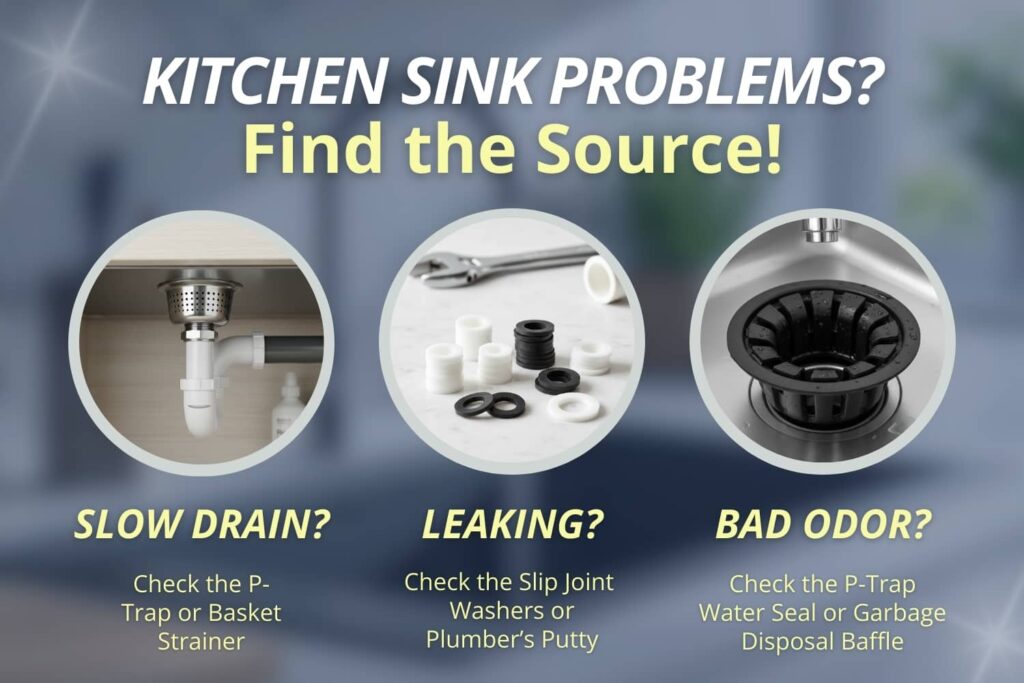
The basket strainer is the metal cup inside the sink drain opening. It catches food and debris before they enter the pipes. The flange is the ring underneath it that seals the strainer to the sink.
Common problems: A dried-out or missing seal (plumber’s putty or rubber gasket) lets water seep under the sink and stain the cabinet floor.
Maintenance tip: If you see water pooling around the strainer after running the tap, the seal likely needs to be redone.
Tailpiece
The tailpiece is the short, straight pipe that carries water from the basket strainer down to the P-trap.
Common problems: Leaks at the slip-joint connection, corrosion in older metal tailpieces, and incorrect length that misaligns the joint below it.
Maintenance tip: Tighten the slip nut by hand plus a small turn. Replace a corroded metal tailpiece with PVC or stainless.
P-Trap
The P-trap is the curved pipe that holds a small pool of water at all times. That water seal blocks sewer gas from rising back into the kitchen.
Common problems: Grease and food debris build up inside the curve, causing slow drainage. The EPA advises against pouring grease down any drain, since it hardens inside the pipe rather than washing away. If the trap dries out, usually in a sink that isn’t used often, odors can escape.
Maintenance tip: Unscrew the trap periodically to clear debris, and run water down an unused drain occasionally to keep the seal intact.
Trap Arm
The trap arm is the horizontal pipe connecting the P-trap to the wall’s drain line.
Common problems: A trap arm without the correct downward slope, about a quarter-inch drop per foot, lets water sit or drain too slowly. A partial clog inside can cause gurgling.
Maintenance tip: If the sink gurgles or drains slowly with a clear trap, check the trap arm’s slope and connections next.
Vent Pipe
The vent pipe regulates air pressure in the drain system so water flows freely instead of getting stuck behind air pockets.
Common problems: A blocked or poorly installed vent causes slow drainage, gurgling, and sewer odors, since negative pressure can pull the trap’s water seal down.
Maintenance tip: Persistent gurgling with no visible clog is often a vent issue, and that’s a job for a professional.
Branch Drain Line
The branch drain line carries wastewater from the trap arm into the home’s larger drainage system, joining other fixtures before reaching the main line.
Common problems: Standing water in the sink, slow drainage across multiple fixtures, or leaks inside walls and cabinets if the line is cracked.
Maintenance tip: If the sink drains slowly even with a clean P-trap and trap arm, the branch line may need a professional inspection.
Main Drain Line
The main drain line is the final pipe carrying wastewater to the home’s sewer or septic system.
Common problems: Multiple drains backing up at once, gurgling toilets, sewage odors, or pooling water near the sewer line outside.
Maintenance tip: If more than one fixture in the house is affected at the same time, that points to the main line, not the kitchen sink.
Quick reference:
| Part | What It Does | Watch For |
|---|---|---|
| Basket strainer & flange | Catches debris, seals top joint | Water pooling, stained cabinet |
| Tailpiece | Carries water to the P-trap | Slip-joint leaks, corrosion |
| P-trap | Holds a water seal against sewer gas | Slow drainage, odors when dry |
| Trap arm | Routes water to the wall drain | Gurgling, incorrect slope |
| Vent pipe | Balances air pressure | Gurgling with no visible clog |
| Branch drain line | Carries water to the main system | Multi-fixture slow drainage |
| Main drain line | Final exit to sewer/septic | Multiple drains backing up |
What These Parts Are Made Of: PVC vs. ABS vs. Brass vs. Stainless
Most kitchen sink drain parts are made from one of four materials, and the right choice depends on whether the plumbing is hidden or visible.
| Material | Durability | Cost | Best For |
|---|---|---|---|
| PVC | Good | Low | Hidden cabinet plumbing, most common choice |
| ABS | Good | Low–Medium | Regions where local code favors ABS |
| Brass (chrome) | Very good | Medium–High | Exposed plumbing, heat resistance |
| Stainless steel | Excellent | High | Premium or commercial installs |
Most kitchen sinks use a 3-1/2 inch strainer opening connected to 1-1/2 inch tubular pipe below. If a trap doesn’t reach the wall, extensions and couplings can bridge the gap, but mixing ABS and PVC requires a listed transition fitting, not standard cement, since gluing them directly won’t hold a seal.

Signs of a Drain Pipe Problem: A Home Inspector’s Checklist
A home inspector looks at kitchen sink drain parts differently than a DIYer replacing a washer. Under InterNACHI’s Standards of Practice, a plumbing inspection covers the visible drain, waste, and vent system, so during a plumbing inspection we’re checking for the signs that predict a future failure, not just fixing today’s leak.
Here’s what we look for under a kitchen sink:
- Corrosion or staining on metal tailpieces and traps — an early sign of a slow leak that hasn’t been noticed yet
- Incorrect trap arm slope — too flat and water sits; too steep and the trap can lose its water seal
- Mismatched materials at a joint — ABS glued directly to PVC, or metal threaded into plastic without the right compound
- A dry trap in a rarely used sink — this lets sewer gas into the kitchen even though nothing is technically broken
- Overtightened or cracked slip nuts — a common DIY mistake that causes slow drips instead of solving them
- Missing cleanout access — makes future clogs harder and more expensive to clear
These issues rarely show up as an emergency. They show up as a line item on an inspection report, and catching them before closing on a home (or before they get worse in a home you already own) is usually far cheaper than an emergency repair call. found, they can recommend the next steps before the problem worsens.
Related Questions to Explore
What are the parts of a kitchen sink drain called?
The main parts are the basket strainer, flange, tailpiece, P-trap, trap arm, vent pipe, and branch or main drain line. If there’s a garbage disposal or dishwasher connection, those tie into the same system through the tailpiece or disposal outlet.
Are kitchen sink drain parts universal, or do sizes vary?
Most kitchen sink drains share a 3-1/2 inch strainer opening and 1-1/2 inch tubular pipe, which fits the majority of home sinks. Bar sinks and some older models use different sizes, so it’s worth measuring before buying replacement parts.
What is a drain slip joint, and why does it matter?
A slip joint is a slip nut and beveled washer that compresses to form a watertight seal without gluing the pipe. It’s what lets you take a P-trap apart to clear a clog and put it back together without cutting anything.
Why does my kitchen sink smell like sewer gas?
The most common cause is a dry P-trap, which loses its water seal in a sink that isn’t used often. A blocked vent pipe or a loose slip joint above the trap can cause the same smell. Running water down the drain often solves it; if the odor comes back, a plumbing inspection can pinpoint the cause.
What’s the rubber part under a kitchen sink called?
That’s usually the rubber gasket or washer that seals the basket strainer to the sink, or the beveled washer inside a slip joint. Both wear out over time and are common sources of small drips.
How do I know if a drain issue needs a plumber or a home inspection?
A single slow drain or a small drip at a slip nut is usually a DIY fix or a quick plumber visit. If you’re buying a home, seeing corrosion on multiple fixtures, or dealing with recurring odors and slow drainage across more than one drain, that’s a sign to get a full home inspection rather than patching one symptom at a time.
When to Call a Professional
Most drain part issues (a loose slip nut, a dry trap, a worn gasket) are simple fixes. But some signs point to something bigger than a single part:
- Multiple drains in the home are slow or backing up at the same time
- You’re seeing recurring leaks even after tightening or replacing a part
- There’s staining, soft cabinet flooring, or visible mold under the sink
- You’re buying or selling a home and want a clear picture of the plumbing before it’s final
P.I. Home Inspection Services serves Batavia, IL, Chicago, and the surrounding suburbs seven days a week, including evenings, with computer-generated inspection reports delivered in under 24 hours. If any of the signs above sound familiar, a plumbing inspection is a fast way to know exactly what you’re dealing with.
Conclusion
A kitchen sink drain relies on seven connected parts, and most problems trace back to one of three things: a worn seal, an incorrect slope, or a dry trap. Knowing what each part does makes it easier to describe the problem accurately, whether you’re calling a plumber or asking an inspector to take a closer look.
If you’d rather have a certified inspector check the whole system before small issues become expensive ones, schedule a home inspection with P.I. Home Inspection Services today.
