
Our test gives you a measured result for your home, not a guess. Here is how it works.
Radon Testing in Chicago, IL
What Is Radon and Why Does It Matter?
Radon testing in Chicago tells you whether the radioactive gas in your basement or lowest level is above the EPA action level of 4.0 pCi/L. P.I. Home Inspection Services, LLC tests homes across Chicago and the western suburbs seven days a week, including evenings. You can’t see, smell, or taste this gas, so a test is the only way to know. According to the Illinois Department of Public Health, 41 percent of Illinois homes tested had levels above that action level.
Our team is led by InterNACHI Certified Master Inspector Mark Sylvester. We bring 20+ years of Chicagoland inspection experience and a hands-on construction background to every test.
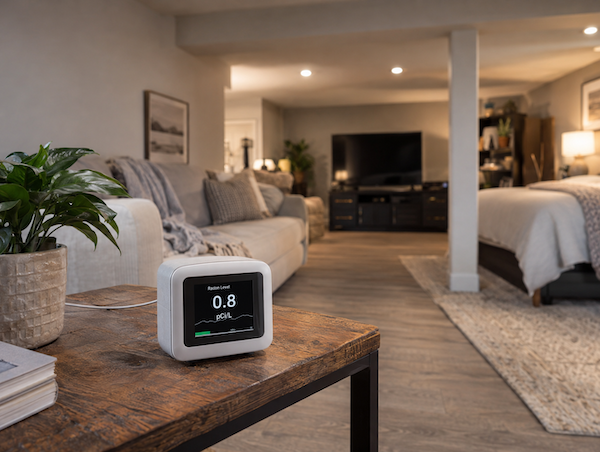
What's Included in Our Radon Testing
Test Placement
We place a calibrated monitor in the lowest livable level of your home, such as a finished basement. Levels are usually highest there, because the gas enters from the soil under your foundation.
Closed-House Conditions
We ask you to keep windows and exterior doors closed starting 12 hours before the test and during it. Normal coming and going is fine. This keeps the reading accurate.
48-Hour Measurement
The monitor runs for at least 48 hours. A short test like this gives a reliable snapshot of your home’s level.
Pickup and Data Review
We retrieve the monitor and review the readings. We check that the test ran under proper conditions before we report a number.
Written Results
You get a clear result in pCi/L, how it compares to the 4.0 action level, and what to do next.
Homes We Test
We test single-family homes, condos and townhomes, multi-unit buildings, and new construction. Most of our customers call us in one of these situations:
- Buying a home: Test during your inspection period so you know the result before closing.
- Selling a home: A current result helps you avoid surprises when a buyer’s inspector tests.
- Living in your home for years: The gas can build up with no warning signs at all.
- After renovations: Finishing a basement or sealing up a house can change your level.
What Affects Your Test Result
Your reading depends on more than your foundation. Here is what we look at when we set up a test.
- Foundation cracks and gaps: Openings around pipes, sump pits, and floor joints let soil gas in.
- Weather and season: Cold weather and heavy rain can push levels up, which is why a short test is only a snapshot.
- Ventilation: Open windows and fans can lower a reading and hide a real problem. That is why we ask for closed-house conditions.
- Which level you use most: A finished basement bedroom matters more than a storage cellar.
Why Choose P.I. Home Inspection Services?
- 20+ years of experience: We have inspected Chicagoland properties for over two decades.
- Certified Master Inspector: Mark Sylvester holds InterNACHI’s top inspector designation, and you can verify it online.
- Hands-on construction background: We know how homes are built, so we know where soil gas gets in.
- Open seven days a week: We schedule evenings and weekends to fit your closing timeline.
- One team for specialty tests: Mold, infrared, sewer scope, and more are done in-house.
- Fast, clear reports: Our reports are photo-backed and easy to read.
Service Area
P.I. Home Inspection Services serves Batavia, IL and up to 40 miles out, covering DuPage, Kane, Cook, and McHenry counties.
Cities We Regularly Inspect
Batavia, Geneva, St. Charles, Bartlett, Elgin, South Elgin, Naperville, Lombard, Carol Stream, Addison, Hoffman Estates, Yorkville, Bloomingdale, Willowbrook, Darien, Chicago, and McHenry.
If your address falls within roughly 40 miles of Batavia and you don’t see your suburb listed, call to confirm. Coverage is drawn by distance, not just by the named list.
Certifications & Standards
P.I. Home Inspection Services is led by Mark Sylvester, CMI®, a Certified Master Inspector through InterNACHI® (International Association of Certified Home Inspectors), InterNACHI ID NACHI05020295. InterNACHI’s $25,000 Honor Guarantee also backs every inspection, so you get added protection on top of a documented report.


Frequently Asked Questions
How much does radon testing cost in Chicago?
Cost depends on the size of the property and how many areas need testing. Call for an exact quote.
How long does a radon test take?
A professional short-term test runs at least 48 hours. We place the monitor, retrieve it, and review the data. You then get a written result.
What is a dangerous radon level?
The EPA and the Illinois Emergency Management Agency recommend taking action at 4.0 pCi/L or higher. The EPA also suggests you consider fixing your home between 2.0 and 4.0 pCi/L.
Is radon common in Chicago and the suburbs?
Yes. The Illinois Department of Public Health reports that 41 percent of Illinois homes tested had levels above 4.0 pCi/L. It can be high in any home, new or old, so only a test tells you your level.
Should I test for radon when buying a home?
Yes. Test during your inspection period so you know the result before closing. If the level is high, you can negotiate repairs or plan for a reduction system.
What happens if my radon test is high?
A result at or above 4.0 pCi/L means you should lower the level in your home. The usual fix is a mitigation system installed by a licensed contractor.
How often should I retest my home?
Retest every two years and after any renovation or addition, based on Illinois Emergency Management Agency guidance.